
Artist’s Statement
A Contemporary Homage to Eric Ravilious: Exploring how modern digital art can offer a dreamscape inspired by the great English landscape painter.
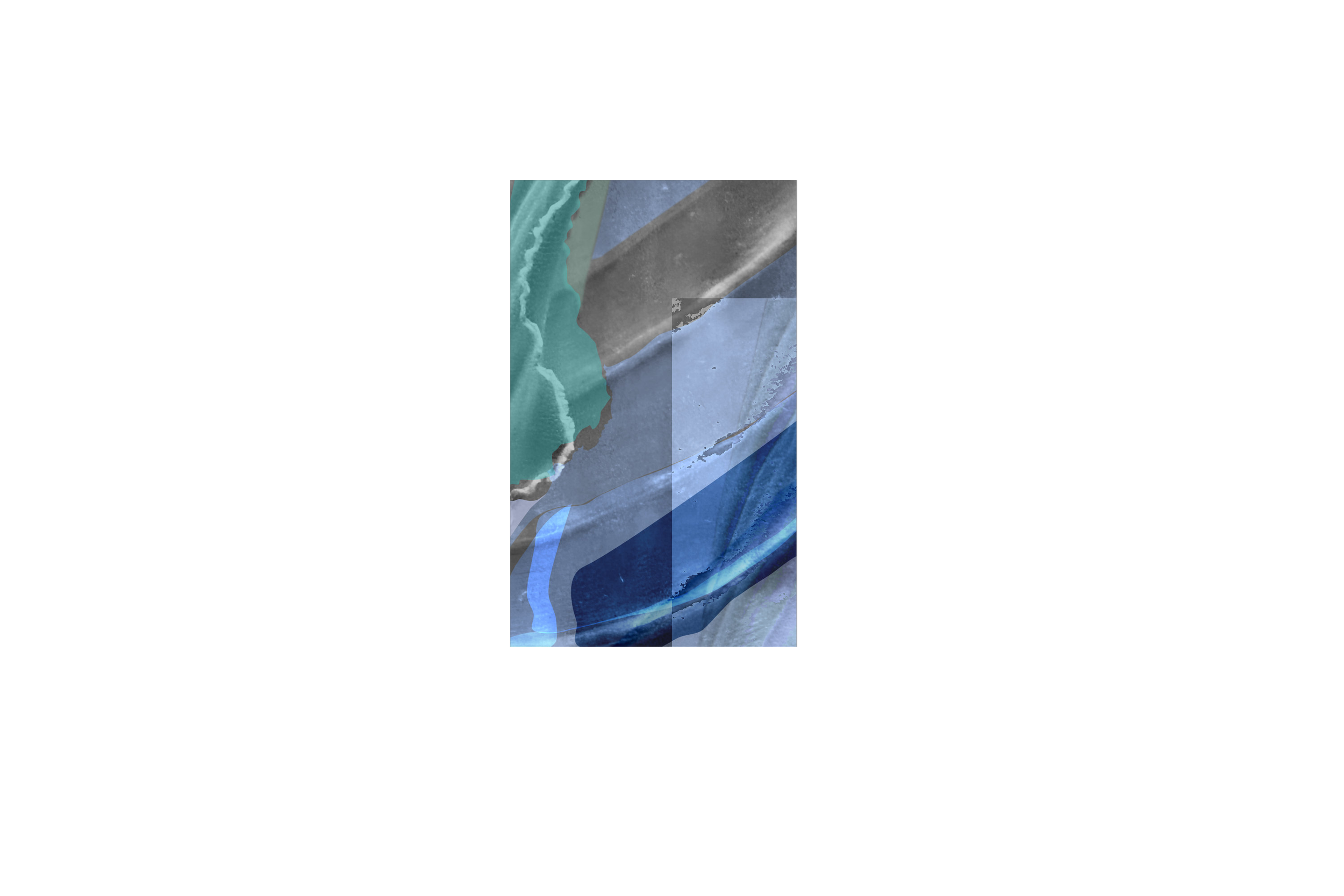
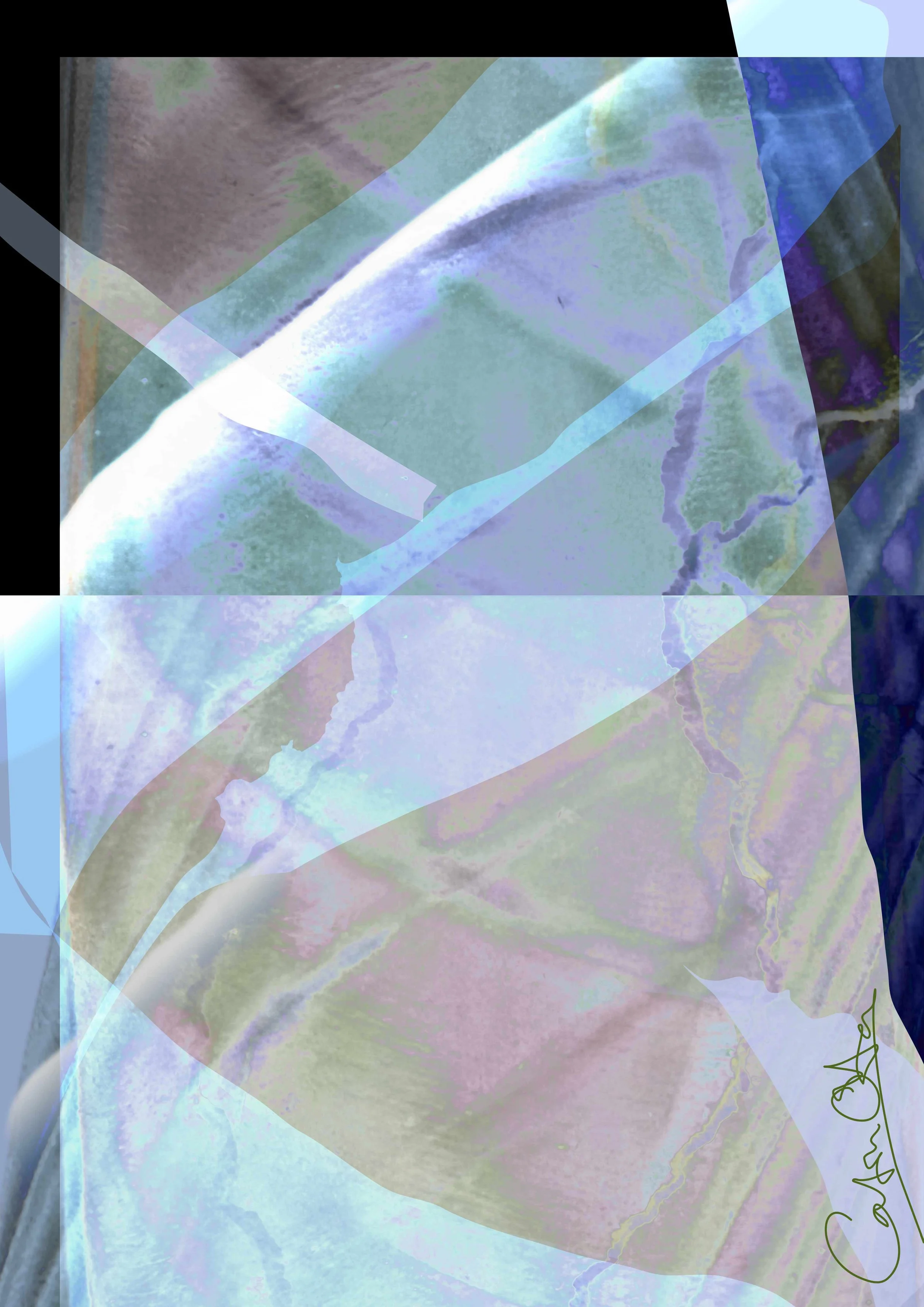
Ravilous Dreams, marries bold digital craftsmanship with a poignant art‑historical reference. Rendered in crisp vector blocks, photomontages and blend layers an exuberant leaf is transfigured as it flows across the three pieces, its pastel greens and yellows recalling the cool‑toned palette of Sussex‑born artist Eric Ravilious (1903‑1942).
Beyond its playful surface, the piece explores a tension between containment and release: the leaf’s curving indentations pierce the borders, while a semi‑opaque strip of tape hints at an imminent rupture. This visual dialogue subtly echoes Ravilious’s own tragic fate—the first British war artist to fall in combat over Iceland in 1942—infusing the work with an unexpected depth and historical resonance.
The three canvases that make up Ravilious Dreams emerged from a moment when sunlight hit some large leaves on a Bird of Paradise plant in my sitting room. Lit up in this way, the plant looked extraordinarily vibrant, brimming with life, bringing the powerful presence of nature into my space. The "architecture" of the leaves was also very striking—strong diagonal ribs on one leaf, almost like armour plating, against the elegant, curling edge of another leaning against it. From this moment, a 90″×43″ abstract was born that eventually transmuted into a dialogue in triptych form with a favourite artist.
The work was made between November 2025 and March 2026. I began on a single canvas—the leftmost section—intending a single composition. I created vector layer masks above the outlines of the leaves and spent much time simply playing with shapes, opacity, colours, pleasing and less pleasing juxtapositions. Something about the powerful presence of nature in the leaves drew me to the idea of abundance and movement.
As the work progressed, I discovered blend-mode effects that made parts of the leaves look highly textured, almost like colourful rusted metals. This brought me to the idea of nature—like all of us—fighting against the passage of time: an energetic struggle to live, and the theme of containment and release. These themes were, literally, tied together when I realised that a taping motif I had been exploring recently could work well, along with the triptych's "broken frame" form.
I made near-black "frames" for each of the three canvases, but deliberately confused the eye by making them sit on only two sides of each rectangle—top and right for the first two, then left and part of the top for the third. This was a very exciting moment. The three pieces now contained a wave-like flowing composition from left to right, as if the leaves were exploding with life and ready to leave the frames, which in turn could not serve as fully functional boundaries for elements thrumming with such energy.
A playful addition to this sense of half-contained energy was the lightly transparent tapes that sit at the corner of one piece and across the boundary of the first and second. The eye journeys from the conventional framing of the dark bars on the first two canvases to a visual "hiccup" on the final canvas—where the doubling up of vertical frames and elements clearly escaping the frame unsettles any sense of neat containment.
One of the joys of being a self-taught digital artist in her sixties is that I no longer worry about rules as much as I used to. The leaves spoke to me over the months I worked on this piece—of life, struggle, confidence—and eventually the artwork also took on echoes of all the wonderful pictures by Eric Ravilious that had seeped into my psyche years before, re-metabolised into something wholly new.
Studio Notes
The Origin Story:
This work is an example of my contemplative abstract art designed to invite slow paced viewing and offering a space for reflection on the tension between the human need for structure and the flow of life. But this is not how it began…
As an artist, I soak up visual influences like a sponge. These are a deep well of unconscious stimuli that can flow into my work in startling, and joyous, ways. My visit to the large-scale late Matisse exhibition, for instance, led me to explore negative space and the pared-back simplicity of an almost child-like gaze. This influence can be seen at work in my series ‘Plant 1’.
Eric Ravilious, the sadly short-lived Sussex artist, was another such example. He became an almost daily companion for a long while. His work kept floating into my life through visits to the lovely Pallant House Gallery, where I live, and I found myself following his archive on social media, enjoying a new piece almost every day.
Once you know Ravilious, you recognize his work instantly. It is a distinctive style: a restricted palette of cool pastels, dramatic sight lines that pull the eye deep into the composition, wide sweeping perspectives capturing miles of landscape, and sharp angular diagonals set against organic elements. He has been described as "meticulous and approachable"—a duality I would love to embody. In a world on the brink of war, his gaze was other-worldly and charming, yet never sentimental. He seemed happiest creating spaces without people, or with figures inhabiting a folkloric imagination.
A few years have passed since my intense interest in Ravilious, but at the start of 2026, I began working on a new large-scale piece: a triptych abstract that grew from seeing a dynamic, slanted leaf caught in the sunlight in my living room. As the work developed, I realized the impressions of Ravilious had left their trace. Without any intention to pull these influences through, I felt them flowing in the piece. The title, Ravilious Dreams, came bubbling up, crystallizing the sense of a homage—or simply an echo—as the work reached its conclusion.
It takes time to articulate these echoes. Returning to the piece with fresh eyes, I saw the dialogue: the dynamic movement, the strong angular lines forming triangles, the pastel palette, and the absence of human presence.
The "un-Ravilious" elements are ones I hope he might have liked. I played with the idea of framing, suggesting the leaf is too full of life to be held in a frame. By applying near-black framing to only two sides of each of the three panels, I unsettled the evenness of the triptych. The viewer must work to see where one picture ends and another begins. Repeated shapes flow from one panel into the next, breaking the idea of the frame entirely.
Tapes and taping things have been a theme in my work since late 2025. They accentuate the permeable nature of the visual space, sitting across the composition, flowing into the "frame," and joining forces across two of the pictures. Unlike the meticulous maker of lithographs, I am taking the viewer on a playful, uncertain journey, suggesting I may need their help to work out where elements begin and end.
A bit like life.
Beyond the Frame
Created as a human-crafted digital original, this piece stands as a counter-narrative to AI-generated imagery, emphasizing the intentional, hand-guided process of the artist.
I made around twenty digital layers and hand-drawn elements for each canvas, testing and re-positioning them and, over time, harmonised them into a single, flowing whole across the three large partially held spaces. Deep in the process during the weeks of making, I worked at an instinctive, almost visceral, level, feeling for what ‘felt right’. However, setting aside a complex composition of vibrant shapes and colours, I found the work offered me a meditation on the relationship between the enduring vitality of nature and our human desire to make sense of the world and our place in it.
The leaves in Ravilious Dreams do not struggle, victim-like, against their boundaries; they simply exist with such vibrant energy that they transcend them. Their movement is not chaotic, but a powerful, inevitable flow—I came to see in them a testament to the resilience of life that continues, regardless of the frames we attempt to impose. There is a profound peace in witnessing this: the understanding that nature moves with its own rhythm, unburdened by our need to categorise or contain.
The "broken frames" and the translucent tapes are not symbols of rupture, or of the degradation of nature by humankind, but poignant hints at our own fragile humanity. We have a natural instinct to frame the world, to find order in the vastness of the universe and the chaos of sensory overload, and to seek comfort in structure. This is not a flaw, but a part of the human experience. The artwork invites us to acknowledge that instinct while also recognising that the true essence of life—like the leaf in the sunlight—cannot be fully held.
When, head down in my digital studio, I created the broken frames and added the tapes, I was not driven by intellectual or philosophical intent. They simply felt right—intuitively, viscerally perfect for what the piece needed. It was only afterwards, with the luxury of space and reflection, that I began to see what the whole might mean. Standing back from the finished work, I found myself applying a more thoughtful gaze, and these ideas crystallised. I offer them here not as the definitive reading, but as one perspective among the myriad that others may bring to the piece.
Rather than offering answers, Ravilious Dreams offers a reflective space. It is a place to pause, to consider the beauty of the moment, and to open a conversation about how we navigate the tension between our need for structure and the joyful, unstoppable flow of existence. Whatever you bring to this piece—your own experiences of aging, change, or simply the pleasure of being alive—it is here to meet you, not to instruct you, but to resonate and reach out to you.
Join the Conversation
If Ravilious Dreams - The Story has resonated with you, I invite you to join my newsletter. I write occasionally about the slow unfolding of art, the intersection of aging and creativity, and the quiet moments that shape us. No noise, just reflection.